
A Common and Frustrating Garage Door Problem
You press the button on your garage door remote, the door starts moving down, and then — just before it reaches the floor — it reverses and goes right back up. You try again. Same thing. Maybe it works on the third try, maybe it doesn't. Either way, you're left standing in your driveway in Southfield wondering what's going on.
This is one of the most common garage door issues we get calls about, and the good news is that it's almost always fixable. The tricky part is that several different things can cause this behavior, and diagnosing the right one matters. Let's walk through the most likely culprits so you understand what's happening and what to do about it.
Understanding Why Your Garage Door Reverses
Modern garage door openers are equipped with safety features that force the door to reverse if something seems wrong. This is by design — the U.S. Consumer Product Safety Commission has required auto-reverse mechanisms on garage door openers since 1993. So when your door reverses unexpectedly, it's usually because one of these safety systems is being triggered, even when there's no actual obstruction.
Here are the most common reasons this happens:
1. Misaligned Safety Sensors
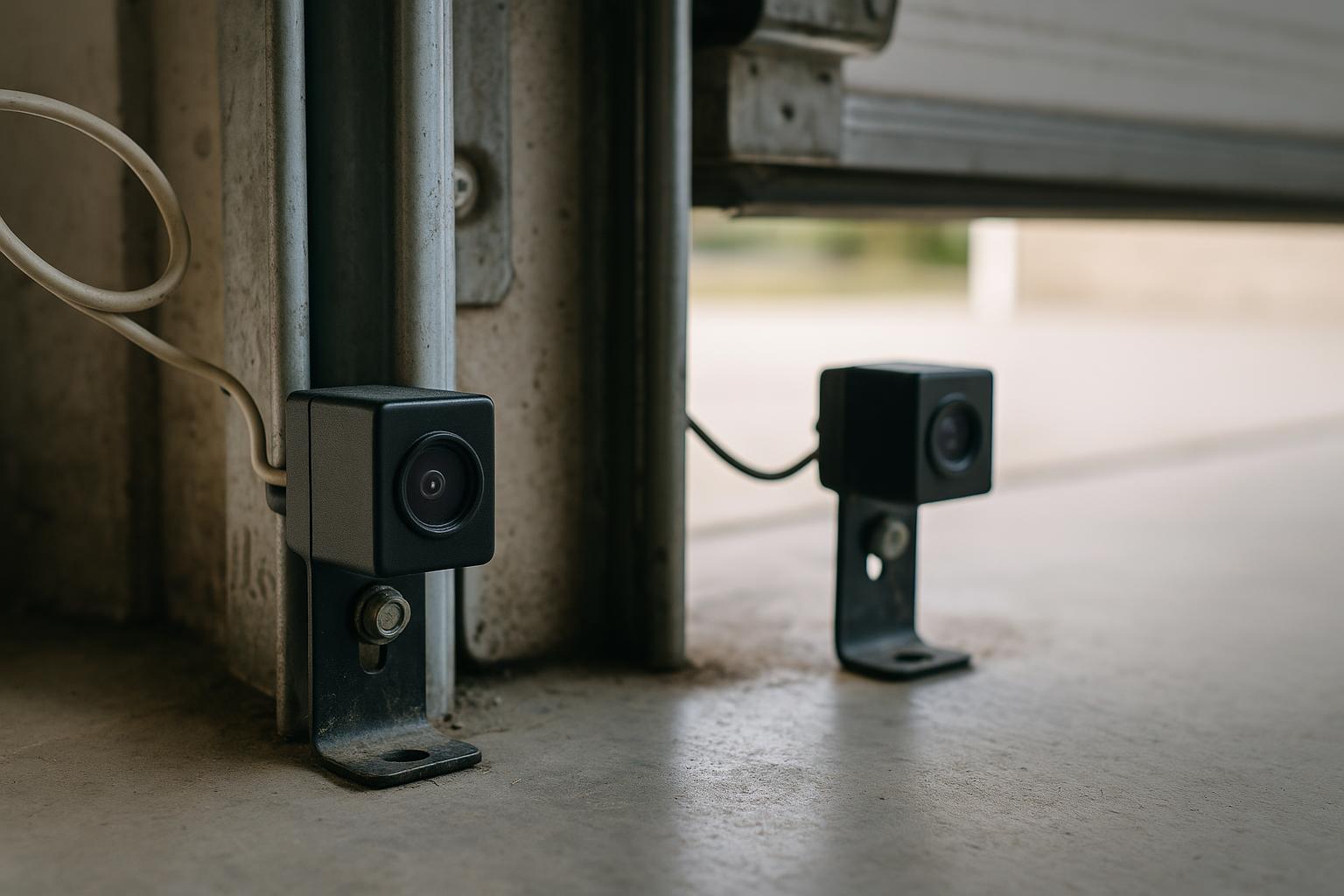
This is the number one cause of a garage door that reverses before closing. Every garage door opener has two photo-eye sensors mounted near the bottom of the door tracks, one on each side. These sensors send an invisible beam across the opening. If anything breaks that beam — a person, a pet, a bicycle — the door reverses to prevent injury or damage.
The problem is that these sensors can easily get bumped, knocked out of alignment, or covered in dirt and cobwebs. When that happens, the opener thinks there's something in the way even when there isn't.
What to check:
- Look at the LED lights on both sensors. Most models show a steady green light when aligned and a blinking light when they're not.
- Gently wipe the sensor lenses with a soft cloth to remove dust or grime.
- Make sure nothing is blocking the beam path — even a small leaf or spider web can cause issues.
- Check that both sensors are firmly mounted and pointing directly at each other.
2. Incorrect Close-Limit Settings
Your garage door opener has limit settings that tell it how far the door should travel before it's fully open or fully closed. If the close-limit setting is off, the opener may think the door has hit something when it reaches the floor, triggering the auto-reverse.
This is especially common after a new opener installation or if someone has recently adjusted the settings. It can also drift over time as parts wear.
What to do: Most openers have adjustment screws or a digital control panel where you can fine-tune the travel limits. Your owner's manual will have specific instructions for your model. If you're not comfortable making this adjustment yourself, this is a quick fix for a professional technician.
3. Worn or Broken Springs
Garage door springs do the heavy lifting — literally. They counterbalance the weight of the door so the opener doesn't have to work as hard. When a spring is worn, weakened, or broken, the door becomes much heavier than the opener expects. The opener senses this extra resistance and reverses because it thinks the door has hit an obstruction.
If you notice your door seems sluggish, makes loud grinding noises, or the springs look stretched or damaged, this is likely the issue. Spring repair is not a DIY job. These components are under extreme tension and can cause serious injury if handled improperly. If you suspect a spring problem, call a professional right away.
4. Track Problems
The metal tracks that guide your garage door up and down need to be properly aligned and free of debris. A bent track, a buildup of dirt or rust, or rollers that have come out of the track can all create resistance that triggers the auto-reverse.
What to check:
- Visually inspect both tracks for bends, dents, or gaps.
- Look for debris, hardened grease, or rust buildup inside the tracks.
- Check that the rollers are seated properly in the track and rolling smoothly.
Minor debris can be cleaned out, but bent tracks or damaged rollers should be handled by a technician to avoid making the problem worse.
5. Opener Force Settings
In addition to travel limits, your garage door opener has force settings that control how much resistance triggers a reversal. If the downward force is set too low, the opener may reverse at the slightest resistance — even the normal friction of the door reaching the floor.
This setting can usually be adjusted on the opener unit itself. However, be careful not to set it too high, as this can override the safety features that protect people and pets. A small, incremental adjustment is usually all that's needed.
6. Damaged or Worn Weatherstripping
Here's one that surprises a lot of homeowners. The rubber weatherstripping along the bottom of your garage door creates a seal against the floor. Over time, this seal can become stiff, warped, or swollen — especially after harsh Michigan winters. When the door hits this rigid strip, the opener may interpret it as an obstruction and reverse.
Replacing the bottom seal is an inexpensive fix that also improves your garage's insulation and keeps out water, pests, and debris.
When to Call a Professional
Some of these fixes — cleaning sensors, clearing debris from tracks, or wiping down weatherstripping — are things most homeowners can handle on their own. But if you've gone through the basics and your door is still reversing, or if the problem involves springs, tracks, or opener adjustments you're not comfortable making, it's time to call in a pro.
At Southfield Overhead Garage Door, we diagnose and fix reversing issues every week for homeowners across Southfield, Royal Oak, Farmington Hills, Beverly Hills, and the surrounding communities. We'll identify exactly what's causing the problem, explain your options clearly, and get your door working properly — usually in a single visit.
Don't Ignore a Reversing Garage Door
It might seem like a minor annoyance, but a garage door that won't close all the way is a security risk and an energy efficiency problem. An open or partially closed garage door invites theft, lets in cold air during Michigan winters, and can allow water and pests into your garage.
More importantly, if the underlying cause is a worn spring or a track issue, the problem will only get worse over time — and more expensive to repair.
If your garage door keeps reversing and you can't figure out why, give us a call. We offer honest pricing, show up on time, and stand behind every repair we do. Southfield Overhead Garage Door is here to help you get back to a door that works the way it should.